What are liquid staking derivatives? How liquid staking tokens work
How liquid staking tokens like stETH, wstETH and rETH work: rebasing vs value-accruing, withdrawals, depegs, slashing, and how to read LST holdings and prices.
A liquid staking derivative, today usually called a liquid staking token (LST), is a token you receive for staking a proof-of-stake asset through a protocol, which keeps earning staking rewards while you hold, trade or lend it. Lido's stETH and wstETH and Rocket Pool's rETH are the best-known examples on Ethereum. This guide explains how they work, the two ways an LST passes rewards on (rebasing and value-accruing), how you get ETH back, what can go wrong (depegs, slashing, contract risk), and how to read a wallet's LST holdings and their price against ETH with the GoldRush token balance API and token price API.
This is not investment advice.
What is liquid staking?
On Ethereum, staking means locking ETH in a validator that proposes and attests to blocks, earning rewards in return. Running a validator yourself takes 32 ETH, a machine that stays online, and the know-how to keep it from being penalized. The staked ETH can't be spent while it is staking; getting it back means exiting the validator and waiting in the protocol's exit and withdrawal queues.
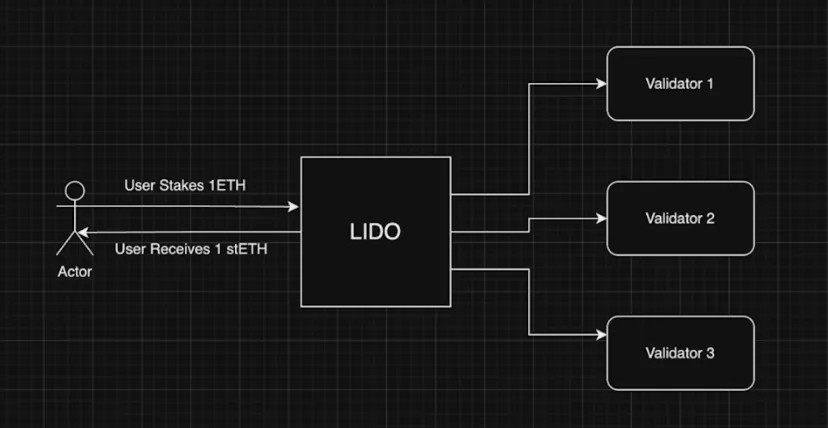
A liquid staking protocol pools deposits of any size, runs validators (or has node operators run them), and gives each depositor a token that represents their share of the pool. That token is the liquid staking token. You keep the staking rewards, and you also get an ordinary ERC-20 you can transfer, swap on a DEX, or post as collateral, without waiting for a validator to exit.
"Liquid staking derivative" (LSD) was the common name in 2021–2022. "Liquid staking token" (LST) is the usual name now, partly because the token is a receipt for staked assets rather than a derivative in the financial sense. Both mean the same thing.
How liquid staking tokens work
The flow is the same across protocols:
- Deposit. You send ETH to the protocol's contract.
- Mint. The contract mints you LST: an amount that represents your share of everything the pool has staked.
- Stake. The protocol assigns the pooled ETH to validators, run by its node operators.
- Accrue. Validators earn consensus and execution rewards. The protocol reports them on chain (Lido through an oracle committee, daily), takes its fee, and credits the rest to LST holders.
- Use. Meanwhile the LST is a normal token: you can hold it, sell it on a DEX, lend it, or use it as collateral.
- Exit. You either sell the LST for ETH on the market, or redeem it through the protocol, which returns ETH from its buffer or by exiting validators.
How step 4 shows up in your wallet depends on the token's design.
Rebasing vs value-accruing tokens
There are two designs, and mixing them up is the most common mistake made about LSTs.
| Rebasing (stETH) | Value-accruing (wstETH, rETH) | |
|---|---|---|
| What changes as rewards arrive | Your balance grows | Each token's value in ETH grows |
| Price against ETH | Stays close to 1 | Rises over time, above 1 |
| Token count | Changes without any transfer | Fixed until you transfer |
| Integration | Needs rebase-aware accounting | Behaves like a normal ERC-20 |
Rebasing: stETH. Lido mints stETH 1:1 for ETH deposited. Each day, when Lido's oracle reports validator balances, every holder's stETH balance is recalculated, so 10 stETH becomes slightly more than 10 the next day. Underneath, Lido tracks each account's shares of the pool and computes the balance as shares × total pooled ETH ÷ total shares. A rebase can be negative if validator penalties outweigh rewards. Two side effects matter to developers, both from Lido's tokens integration guide: stETH does not emit a Transfer event when a rebase changes balances, and because of the integer division, transferring a whole balance can leave 1–2 wei behind.
Value-accruing: wstETH and rETH. The token count stays fixed and each token becomes redeemable for more ETH over time. wstETH is Lido's wrapper around stETH: wrapping converts your stETH into the fixed number of shares underneath it, and stEthPerToken() on the wstETH contract gives the current rate. Rocket Pool's rETH works the same way natively, with the rate from getExchangeRate(). A wstETH or rETH is worth more than 1 ETH, and the gap grows as rewards accrue; it is not a premium or a depeg.
So the direction matters: with a value-accruing LST, 1 token buys more than 1 ETH over time, never the other way round. With stETH, 1 stETH stays a claim on about 1 ETH and you have more of them.
Most DeFi protocols prefer the value-accruing kind, because a balance that changes on its own breaks vaults, AMM pools and bridges that assume balances only move with transfers. That is why lending markets and L2 bridges commonly use wstETH rather than stETH. Vault tokens that follow ERC-4626 use the same value-accruing model: a fixed number of shares, each redeemable for a growing amount of the underlying asset.
Ethereum isn't the only chain with LSTs. Solana has several, such as JitoSOL and mSOL, which are value-accruing tokens over staked SOL.
Redeeming an LST: withdrawals and queues
Ethereum validators could not withdraw at all until the Shapella upgrade in April 2023. Before that, the only way out of an LST was to sell it on the market. Since then, protocols have built redemption paths:
- Lido has a withdrawal queue. You lock stETH or wstETH in the queue contract and receive an NFT (unstETH) that represents your request. Once the protocol has ETH for it, from its buffer, new deposits or validator exits, the request is finalized and you claim ETH. How long that takes varies with demand and with the Ethereum exit queue.
- Rocket Pool lets you burn rETH for ETH directly when the protocol holds enough ETH in its deposit pool and rETH collateral; otherwise holders swap rETH on the market.
Redemption returns the token's protocol value: about 1 ETH per stETH, or the current exchange rate per wstETH or rETH. Selling on a DEX is instant but returns the market price, which can be lower. The difference between the two is where depegs come from.
Risks of liquid staking tokens
Depeg (market discount)
An LST's market price can fall below the ETH it redeems for. That happens when many holders want out at once and the redemption path is slow, so they sell into DEX liquidity instead. In mid-2022, before withdrawals existed, stETH traded below 1 ETH as large holders sold. Withdrawal queues narrow that gap because anyone can buy the discounted token and redeem it, but a long queue still leaves room for a discount. A depeg hurts most when the LST is collateral in a loan: the lending market may value it at the market price and liquidate.
Slashing and penalties
Validators that go offline lose small amounts; validators that sign conflicting messages are slashed and forcibly exited with a larger loss. In a pool those losses are shared by every LST holder: a negative rebase for stETH, a lower exchange rate for value-accruing tokens. Protocols reduce the risk by spreading stake across many operators, and some keep an insurance or bond layer (Rocket Pool's node operators post their own ETH alongside pooled ETH).
Smart contract and oracle risk
Your ETH is held by the protocol's contracts and its rewards reported by an oracle. A bug in either, or a compromised upgrade key, can lose or misprice funds. Look for audits, a bug bounty, how upgrades are governed, and what sanity checks the oracle has.
Operator and governance concentration
The protocol chooses which node operators run validators and governs fees and upgrades. Concentrated stake in one protocol or a few operators is a risk to holders and to Ethereum's decentralization.
Layered risk in DeFi
An LST used as collateral, looped for leverage, or restaked into a liquid restaking token (LRT) stacks each protocol's risks on top of the LST's own. A depeg that is a small paper loss for a holder can be a liquidation for a leveraged position.
Read LST holdings and prices with GoldRush
Two GoldRush Foundational API endpoints cover the data side of LSTs:
- Token balances for address (
balances_v2, 1 per call): every ERC-20 a wallet holds on a chain, with rawbalance,contract_decimalsand a USDquote. Because it reads the balance at the current block, a stETH balance includes every rebase so far, with noTransferevents to replay. - Historical token prices (
historical_by_addresses_v2, 1 per call): daily USD prices for a list of tokens. Dividing an LST's price by WETH's gives its price in ETH for each day.
Prerequisites: Node.js 18 or later (for the built-in fetch), and a GoldRush API key in the GOLDRUSH_API_KEY environment variable. The two code blocks below make one script: save them, in order, in one file named lst.mjs (the .mjs extension lets the second block use top-level await), then run node lst.mjs.
const API = "https://api.covalenthq.com/v1";const headers = { Authorization: `Bearer ${process.env.GOLDRUSH_API_KEY}` }; // Ethereum liquid staking tokens to look for, and WETH as the ETH price reference. Extend the list as you need.const LSTS = { "0xae7ab96520de3a18e5e111b5eaab095312d7fe84": { symbol: "stETH", kind: "rebasing" }, // Lido "0x7f39c581f595b53c5cb19bd0b3f8da6c935e2ca0": { symbol: "wstETH", kind: "value-accruing" }, // Lido, wrapped "0xae78736cd615f374d3085123a210448e74fc6393": { symbol: "rETH", kind: "value-accruing" }, // Rocket Pool};const WETH = "0xc02aaa39b223fe8d0a0e5c4f27ead9083c756cc2"; async function get(url) { const res = await fetch(url, { headers }); if (!res.ok) throw new Error(`${res.status} ${await res.text()}`); return (await res.json()).data;} // The liquid staking tokens a wallet holds on Ethereum, from the token balances endpoint.async function getLstHoldings(wallet) { const { items } = await get(`${API}/eth-mainnet/address/${wallet}/balances_v2/?no-spam=true`); return items .filter((t) => LSTS[t.contract_address.toLowerCase()] && t.balance !== "0") .map((t) => ({ ...LSTS[t.contract_address.toLowerCase()], amount: Number(t.balance) / 10 ** t.contract_decimals, usd: t.quote, // null when the token has no price }));} // Each LST's daily price in ETH (its USD price divided by WETH's) between two days (YYYY-MM-DD).async function getLstEthPrices(from, to) { const addresses = [...Object.keys(LSTS), WETH].join(","); const data = await get( `${API}/pricing/historical_by_addresses_v2/eth-mainnet/USD/${addresses}/?from=${from}&to=${to}` ); // API keys created since 1 April 2026 get the daily prices in `items`; older keys in `prices`. const byToken = new Map(data.map((t) => [t.contract_address.toLowerCase(), t.items ?? t.prices ?? []])); const eth = new Map((byToken.get(WETH) ?? []).map((p) => [p.date, p.price])); const rows = []; for (const [address, { symbol }] of Object.entries(LSTS)) { for (const { date, price } of byToken.get(address) ?? []) { if (price == null || !eth.get(date)) continue; // no price for that day yet rows.push({ date, symbol, inEth: price / eth.get(date) }); } } return rows.sort((a, b) => a.date.localeCompare(b.date) || a.symbol.localeCompare(b.symbol));}getLstEthPrices reads a list with one entry per token, each with its daily prices. API keys created since 1 April 2026 get them in the entry's items; older keys get them in prices, with items set to null (the GoldRush changelog entry "API Schema Improvements for New API Keys", 19 March 2026). The code reads either. WETH's entry, from a historical_by_addresses_v2 response for WETH on 29 October 2026 made with an older key, recorded on 3 November 2026 and trimmed of its metadata, looks like this:
{ "data": [ { "contract_decimals": 18, "contract_ticker_symbol": "WETH", "contract_address": "0xc02aaa39b223fe8d0a0e5c4f27ead9083c756cc2", "quote_currency": "USD", "prices": [{ "date": "2026-10-29", "price": 2252.9236 }], "items": null } ], "error": false, "error_message": null, "error_code": null}Then call both: add this at the end of lst.mjs. The example address is the wstETH contract itself, which holds the stETH backing every wstETH; use any Ethereum address:
const wallet = "0x7f39C581F595B53c5cb19bD0b3f8dA6c935E2Ca0"; // any Ethereum address for (const h of await getLstHoldings(wallet)) { console.log( `${h.symbol} (${h.kind}): ${h.amount.toFixed(4)}, ${h.usd == null ? "no price" : `$${h.usd.toFixed(2)}`}` );} for (const { date, symbol, inEth } of await getLstEthPrices("2026-11-16", "2026-11-18")) { console.log(`${date} ${symbol.padEnd(6)} ${inEth.toFixed(4)} ETH`);}Run against test responses from the historical token prices endpoint, with daily prices for 16 to 18 November 2026, the second loop prints:
2026-11-16 rETH 1.1749 ETH2026-11-16 stETH 0.9980 ETH2026-11-16 wstETH 1.2507 ETH2026-11-17 rETH 1.1830 ETH2026-11-17 stETH 1.0056 ETH2026-11-17 wstETH 1.2495 ETH2026-11-18 rETH 1.1674 ETH2026-11-18 stETH 0.9931 ETH2026-11-18 wstETH 1.2500 ETHIt shows the two designs side by side: stETH sits around 1 ETH, while wstETH and rETH are each worth more than 1 ETH because of the rewards they have accrued. A few things to know when you adapt it:
- Daily USD prices are approximate. Each token's daily price comes from its own market data, so the ratio moves by up to about a percent from day to day in the run above. That is enough to spot a real depeg, not to measure one to the basis point. For the exact redemption rate, call
stEthPerToken()on wstETH orgetExchangeRate()on rETH. - Use the right baseline. A wstETH at 1.25 ETH is not at a premium; compare it to its own exchange rate, not to 1. Only a rebasing token like stETH should trade near 1 ETH.
- Rebases are not transfers. A stETH holder's reward history can't be rebuilt from transfer events. Take balance snapshots over time, or count shares, instead.
- Other chains and LSTs. The token list is a starting point. Add the contract addresses of the LSTs you care about, and change
eth-mainnetfor tokens bridged to other chains.
For more on what GoldRush offers DeFi apps, see the DeFi API page.
Handle errors from the GoldRush balances and prices endpoints
When a request fails, the API answers with a non-2xx status and the same envelope as a success, with data set to null. The docs show this body for a chain name it doesn't recognize, with HTTP status 501:
{ "data": null, "error": true, "error_message": "Chain nosuchchain-mainnet not supported.", "error_code": 501}get() throws the status and the body, so the script stops with 501 {"data":null,"error":true,…}. error_code always equals the HTTP status, and error_message says what went wrong:
- 501: the chain name is misspelled or not supported, for example after you change
eth-mainnetto a chain the endpoint doesn't serve. The same request keeps returning 501. - 401: the API key is missing or wrong. A request with no
Authorizationheader at all gets an HTML 401 page instead of JSON, which is whyget()reads the body as text before throwing. - 429 or a 5xx: rate limit or a busy backend. Retry after a pause, with backoff.
Failed requests cost no credits. The error handling page lists every code and what to do about it.
Frequently asked questions
What is the difference between a liquid staking derivative and a liquid staking token?
Nothing: they are two names for the same thing. "Liquid staking derivative" (LSD) was common in 2021–2022; "liquid staking token" (LST) is the usual term now, because the token is a receipt for staked assets rather than a derivative contract.
Is stETH the same as ETH?
No. stETH is Lido's token for ETH staked through Lido, redeemable 1:1 for ETH through Lido's withdrawal queue. It usually trades close to 1 ETH on the market, but it can trade at a discount when many holders sell at once, and it carries Lido's contract, oracle and slashing risks, which ETH does not.
Why is wstETH or rETH worth more than 1 ETH?
They are value-accruing tokens. The number of tokens you hold stays fixed and staking rewards raise the amount of ETH each token redeems for, so their price in ETH rises over time. That is expected and not a premium.
How do I get ETH back from a liquid staking token?
Either sell the token on a DEX, which is instant at the market price, or redeem it through the protocol, which returns its full protocol value but can take time. Lido uses a withdrawal queue that issues an NFT for each request; Rocket Pool lets you burn rETH for ETH when it has enough ETH available.
What happens to liquid staking tokens if a validator is slashed?
The loss is shared by everyone in the pool. For a rebasing token like stETH, balances go down in the next report; for a value-accruing token like wstETH or rETH, the exchange rate drops. Spreading stake across many operators limits how much one slashing can cost.
Can I track liquid staking token balances and prices with an API?
Yes. The GoldRush token balances endpoint returns every token a wallet holds, including LSTs, with current balances that already include stETH rebases, and the historical token prices endpoint returns daily prices you can divide by WETH's to get an LST's price in ETH. The code above uses both.
Next steps
- Token balances reference: every field the holdings code reads.
- Historical token prices reference: date ranges, multiple tokens per call, and quote currencies.
- What is ERC-4626?: the vault standard that uses the same value-accruing share model.
- How to calculate impermanent loss: what happens when you provide an LST and ETH as liquidity.
- GoldRush Foundational API: the rest of the wallet, token and pricing endpoints.